
The Bar
Our Barristers’ Representative, Sam Meardon, facilitates networking opportunities and organises professional development events that connect students with practising barristers and leading legal professionals. Acting as the bridge between Chambers and the Law Society, Sam coordinates and hosts workshops, panel discussions and Q&A sessions to give members direct access to insights on advocacy, case preparation, ethics and career pathways.
Sam’s role strengthens ties between the Society and the Bar, enhances practical learning for members and helps students develop the professional network and skills needed for a career at the Bar.

Barristers are legal professionals who provide both legal advice and advocacy to solicitors and clients. The public primarily seek solicitors for legal advice and seek barristers for representation in court.
As a barrister in court, you may need to conduct examinations and communicate clearly and convincingly to judges and juries. Alongside advocating in court, you also conduct research alongside preparing cases and legal documents. In your career as a barrister, you will work in contact with other legal professionals and clients.
Whilst a demanding career involving long hours and difficult deadlines, a career at the bar contains many benefits including the freedom of being self-employed and a higher wage. A career at the bar can be shaped to personal preferences with barristers able to progress in their career to take silk as a Kings Council (KC) or become a judge.
What is a Barrister?
-
Complete an undergraduate Law degree or a non-Law degree with a Graduate Diploma in Law (GDL).
-
Enroll in one of the four Inns of Court: Lincoln’s Inn, Gray’s Inn, Middle Temple, or Inner Temple.
Have passed the Bar Course Aptitude Test (BCAT), the summer before you begin your Bar Course.
The Bar Course also includes 12 vocational qualifying sessions with your chosen Inn.
Some modules (sessions) include Advocacy, Civil Litigation & Evidence, Criminal Litigation and Evidence & Sentencing.
Once the qualifying sessions are completed, you can be then Called to the Bar by your Inn.
-
This consists of a period of work-based practical training under the supervision of an experienced Barrister; known as a Pupillage.
Obtaining a Pupillage is very competitive and demanding, note the likelihood of achieving a pupillage via the Pupillage Gateway.
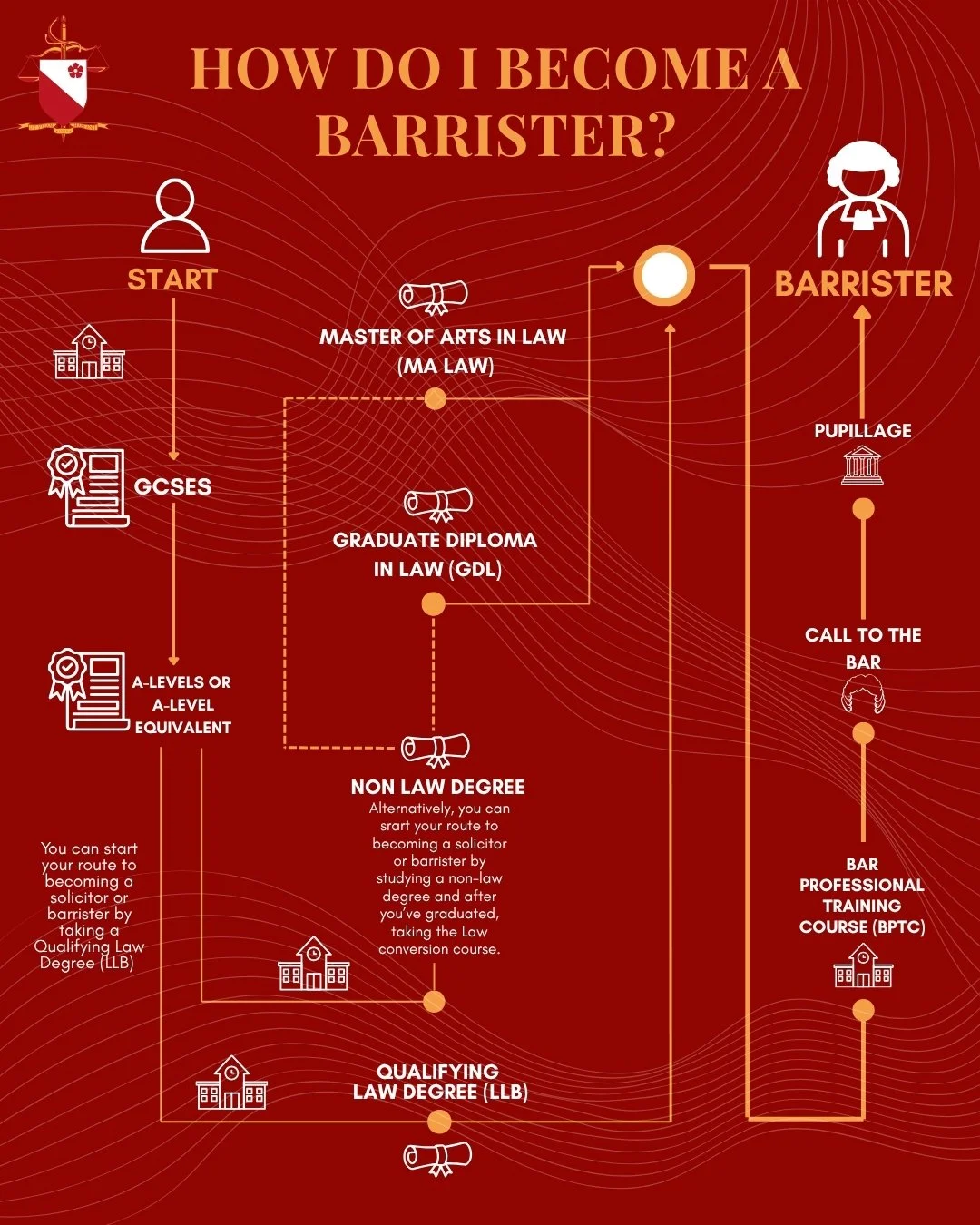
How To Qualify as a Barrister
Further Information & Advice
Inns of Court
There are four Inns of Court in England and Wales: Lincoln’s Inn, Gray’s Inn, Middle Temple and Inner Temple, all located in central London. Membership of one of these Inns is required to become a barrister; once you join an Inn you cannot join another.
During the vocational stage, your Inn will support you while you complete the Bar course, for example through scholarships, mentoring and networking opportunities. Applications to join an Inn must be submitted by 31 May in the year you will start the Bar course (typically at the end of your final academic year).
For further advice, some information can be found here.
Pupillage
Pupillage is the final stage of training to become a barrister following completion of the Bar course. It is work-based and takes place under the supervision of an experienced barrister, either in chambers or in-house. Normally lasting one year, pupillage comprises two stages — a non-practising and a practising period — during which you gain practical experience of what you learned in your undergraduate and vocational training.
Expect a competitive application process: places are limited and many applicants do not secure pupillage on their first attempt. The Pupillage Gateway limits applicants to 20 applications per year, so plan your applications carefully. Many prospective candidates spend time strengthening their legal experience as a county court advocate, paralegal or in similar roles before reapplying.
Apply one to two years in advance, usually during the final year of your degree or while on the GDL. Applications are typically submitted from January to February; check application deadlines which can be found here.
When choosing where to do pupillage, consider the chambers or organisation, location, client base, reputation and practice areas. On successful completion of pupillage you will be eligible to become a fully qualified barrister regulated by the Bar Standards Board.
Applications
Applications for pupillage are most commonly submitted via the Pupillage Gateway, though some chambers advertise vacancies independently or through other specialist portals. Applications for Bar courses, pupillage training courses and related postgraduate programmes are managed by different providers and should be checked directly with the relevant institutions.
Mini‑pupillages and other work‑based experience are valuable for insight into life at the Bar and for strengthening applications. These opportunities are competitive, so applicants should prepare thoughtfully: tailor personal statements and covering letters to each set of chambers, ensure CVs are clear and well structured, and meet all eligibility and deadline requirements.
Many online guides show strong approaches to CVs, covering letters and full applications; applicants should consult multiple sources, adapt advice to their circumstances, and, where possible, seek feedback from practitioners, careers advisers or mentors.
Advice
A career at the bar is challenging yet rewarding. Extensive study and work are necessary both to become a barrister and to thrive in the profession. Due to the competitive nature of the bar, applicants are encouraged to gain as much legal experience as possible to increase their attractiveness as pupillage candidates.
Extracurricular activities are key to expanding a legal CV; mooting and mock trial competitions, for example, develop spoken advocacy, an essential quality for the bar. Experience with legal professionals, such as mini‑pupillages and marshalling, is also recommended, as it demonstrates genuine passion and a specific interest in a career as a barrister.
If you have any other questions, please contact Sam here: sm1301@student.le.ac.uk